
The New Burr Conundrum
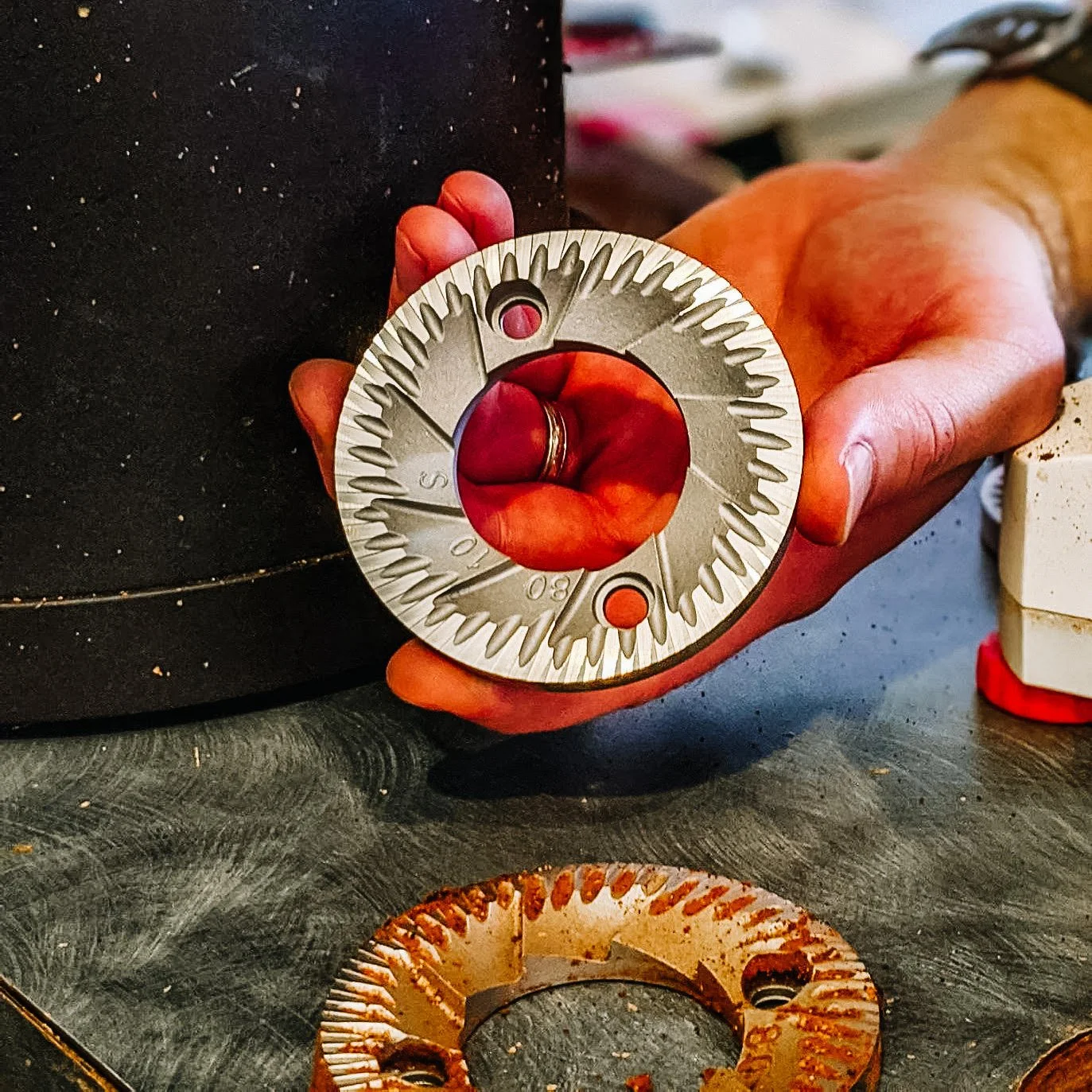
If you’re a home brewer, you may have never replaced a set of burrs on a grinder, but if you work in coffee, it’s routine - every few months most likely. In this post, I’d like to dive in to one of the most annoying things that can possibly happen when you replace a set of burrs: you replace them, and then your coffee tastes even worse than it did before.
How can this be? For years, I’d always assumed one of two things must be happening. First option was that I must have missed a speck of coffee in between one of the mating surfaces, either between the rotating burr and the carrier, or between the stationary burr and the grind chamber housing. So I’d take everything apart, not see any pieces of coffee on the mating surfaces, but still wipe everything down with a clean towel anyway, and put everything back together. Sometimes, the coffee would immediately taste much better, and sometimes it would be just as bad, or even worse. If it was better, great, job done. If it was worse, I’d just do it again until it got better, but never really understood why it was bad in the first place or why it got better.
Second option was that the burrs needed seasoning, but a few times I tried grinding a few dozen pounds of coffee and it didn’t get any better. So I’d end up doing the same thing: take everything apart, make sure everything is perfectly clean, reassemble, and hope for the best.
This always bothered me, because I never really understood why it would sometimes get better and sometimes not. Finally, it dawned on me. The issue is balance.
Have you ever driven in a car that shakes and vibrates when driving at high speeds, perhaps only at certain speeds? Most of the time this is because the tire/wheel combination is not balanced. Neither the tire nor the wheel itself are absolutely perfectly symmetrical, and neither is the combination of the two of them when you put them together. When you spin it tire/wheel combo quickly (at highway speeds, most wheels are spinning somewhere in the 500-1000 RPM range), the little imbalance in weight makes it not spin in a perfect circle (and will also wear out your wheel bearings). This is why wheel weights are a thing - tiny little weights get added in order to balance the tire/wheel combo and make it spin in a more perfect circle (it is of course never really absolutely perfect).
The exact same thing happens with the coffee burr carrier and burr, which are supposed to rotate in a perfect circle around the motor axis. If the carrier/burr combination is imbalanced slightly, then it doesn’t spin perfectly, but it wobbles a bit around the axis, which makes the ground coffee come out at all different sizes as the distance between the stationary burr and rotating burr is constantly changing.
Coffee burrs spin at pretty much the same rate as tires at highway speeds spin (Baratza Encore ~500rpm, Baratza Vario ~1300rpm, Mahlkonig EK43 ~1500rpm) but are much lighter and smaller in diameter than tires, so problems with imbalance aren’t as noticeable. However, the acceptable amount of eccentricity with a coffee grinder is much, much smaller than it is for a car because we want the spacing between the burrs to be as consistent as possible. Somewhat ironically, the larger commercial grinders that have bigger burrs and spin faster than home grinders are more susceptible to having problems with balance.
In most cases, there isn’t really any space to add weights to balance the carrier/burr combination, so the best solution to new burrs making coffee taste bad is to just take everything apart and rotate the burr with respect to the carrier, put it back together, and see if it is better. The rotation (hopefully) makes the slight imperfection in the weight distribution of the burr cancel out the slight imperfection in the weight distribution of the burr carrier. It might make it worse. In which case, you have to rotate it more. There will be some orientation which most evenly distributed the weight and balances the system, which minimizes the wobble and makes the coffee taste the best.
This balance issue also explains why trying to re-align a grinder’s burrs (make them perfectly parallel to each other) is often a fools errand. Most of the time, the issue isn’t that the burr carrier is holding the rotating burr parallel to the stationary burr. The issue is that the burr carrier/rotating burr wobble as they spin. Adding a shim might help, but only at one particular rotation speed. The problem is that the rotation speed varies depending on the load, and the amount of wobble also depends on the rotation speed (back to our car analogy, most of the time with unbalanced wheels you get vibration at certain speeds but not others due to resonance). The no-load speed of a motor is highest, and it spins slower and slower the more load is applied. A finer grind setting is a higher load. When aligning burrs, you typically check for alignment with no load. But when you are actually grinding coffee, the rotation speed and amount of wobble is different, so in practice, unless the carrier/burr combo is very close to perfectly balanced, no amount of shimming will give you a more uniform grind and better-tasting coffee.
