
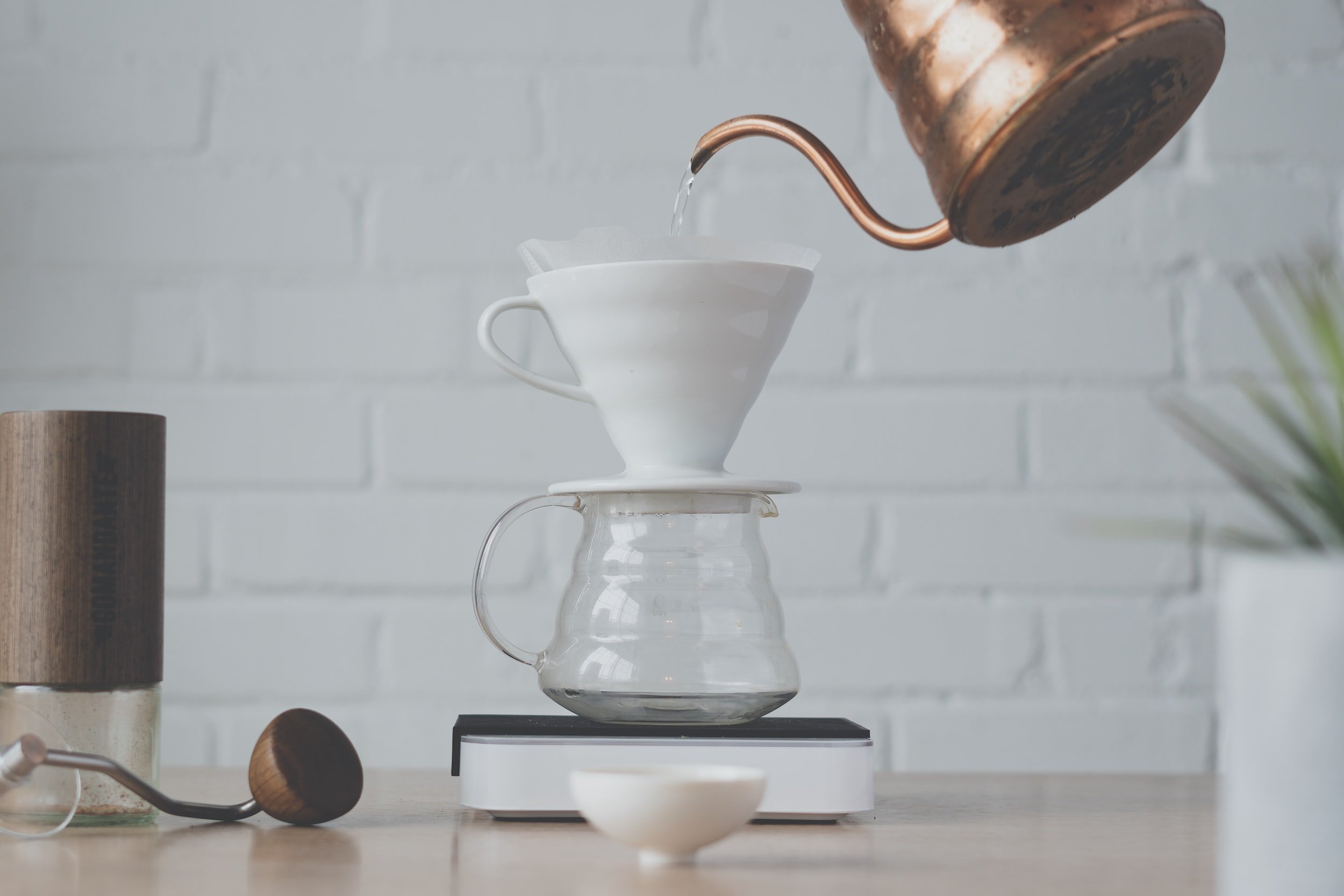
Highest Extraction Hario V60
Recommended for light roasts when you struggle to get enough sweetness regardless of what you do with your grind size using our standard V60 recipe
What You’ll Need
21 grams of specialty-grade whole bean coffee
Filtered water (210-211 degrees F)
Gooseneck kettle
Scale
Timer
V60 cone & filter
Mug or carafe
Burr grinder
1.
Fold V60 filter and insert into cone, rinse and pre-wet filter with hot water into serving carafe or cup, discard hot papery water.
2.
Grind size: Table salt (about "medium-fine" - 24 clicks on a Comandante C40 is a good starting point). Flatten coffee bed. Zero scale.
3.
Start timer. At 0:00, pour 60-70 grams spiraling all over the grounds quite quickly (10+ grams/second). If you do not get all the grounds saturated with your pour alone, gently excavate/flip over the grounds with a spoon and/or chop up any dry clumps. If you do get all the grounds saturated with your pour alone, just leave it alone.
4.
At 0:40, begin the first main pour. Aim to reach 190g total water in the brewer by 1:00-1:05. Pour in circles/spirals. Flow rate here is about 5-6g/sec–this is relatively slow but probably not as slow as you can possibly pour without the stream breaking up. If you really want to fine tune this process, your first 2-3 seconds of this pour should be at more like 6-8g/s to really make sure the bed is evenly saturated and the rest of the water will flow through evenly, and then you want to slow down.
5.
When you can see the grounds about to become exposed to the air, begin the second pour. Pour to 280g total water, again at around 5g/sec, maybe just a little slower than your first pour.
6.
When you can see the grounds about to become exposed to the air, begin the third and final pour. Pour to 375g total water, again at around 5g/sec, maybe just a little slower than your first pour.
7.
Swirl entire brewer to wash any grounds that have gotten stuck to the filter back into the wet coffee bed.
Note that there is no reference to total brew time at all here. With a great grinder (very little fines), you’ll get faster brews. With a cheaper grinder, you’ll get slower brews. With some anaerobic or otherwise experimentally-processed coffees, you’ll get very fast brews. With dense coffees like Ethiopians, you’ll get slower brews. Being consistent with your excavation (if applicable) and pouring is the important thing, and then dial in grind size to suit your tastes.